STRATEGIC PLAN & DEPLOYMENT
The Vision and Mission
The College is committed to a model of quality education that is equitable and leads to the holistic development of all stakeholders. The motto of the College, “Tejasvi-naavadhitam-astu”, taken from the Taittiriya Upanishad, means, “May our learning be endowed with radiance.” Serving a wide cross section of students, Atma Ram Sanatan Dharma College provides quality education in Humanities, Science, and Commerce while ensuring all-round development.
The College ensures a barrier-free, non-discriminatory, and supportive ecosystem. It is dedicated to creating opportunities for women and differently abled students in a safe, nurturing environment, fostering a joyful ecosystem where students maximize their potential while cultivating their conscience.
The Objectives
The College focuses on learner-centric teaching and dynamic interactive learning fostered by:
- Developing core competencies along with valuable life skills
- A strong focus on research-based activities
- Innovative teaching practices incorporating ICT
- Instilling a strong sense of social responsibility in students
- Modernization and upgradation of infrastructure, laboratories, learning resources, and computational facilities
The College, a constituent of the University of Delhi, follows UGC rules and University statutes regarding appointments, teaching, admissions, examinations, and research.
- The College is governed by an experienced Governing Body.
- The Principal is the academic and administrative Head.
- The Internal Quality Assurance Cell maintains scholastic and co-scholastic quality standards.
- The Administration includes the Bursar, PIO, Liaison Officer, AO, and Section Officers.
- The Staff Council functions through various committees with active faculty and student involvement.
- Specialized cells such as NSS, NCC, E-Cell, Placement Cell, and Skill Hub provide value addition.
- Thirteen departments function under rotating coordinators/TICs.
- A well-stocked library provides access to e-resources and research databases.
The College follows a decentralized framework where staff and students actively participate in governance through committees, councils, and student bodies. Alumni also contribute significantly to institutional development.
Perspective Plans
- The College is in the process of implementing the New Education Policy.
- We plan to organize more skill-based, vocational, entrepreneurial, and other add-on courses to impart employable skills and help students become future entrepreneurs.
- We plan to enter into collaborations with other research partners to extend and deepen academic and research cooperation.
- To encourage research and innovation among faculty and students, the College is enhancing its infrastructural facilities.
- We are in the process of initiating a multidisciplinary bilingual research journal.
- We propose to conduct more interdisciplinary national and international seminars, FDPs, training programmes, and workshops to enable researchers, industry experts, academicians, and students to exchange views on contemporary issues.
- To create an environmentally conscious campus, we plan to adopt sustainable energy solutions such as installing solar rooftop power plants and implementing waste management systems including a sewage treatment plant.
- Initiate and strengthen measures to improve the public perception of the College.
- For increased stakeholder engagement, we plan to establish a Parents–Teachers Association.
- Strengthen industry–academia collaboration and encourage alumni engagement in College activities.
- Enhance institutional outreach activities through active participation of College societies in collaboration with communities, NGOs, and Self-Help Groups.
- Ensure constant upgradation of ICT facilities in the College.
The college facilitates optimum utilization of institutional capabilities for the successful deployment of its perspective plans as evident from the following initiatives:
-
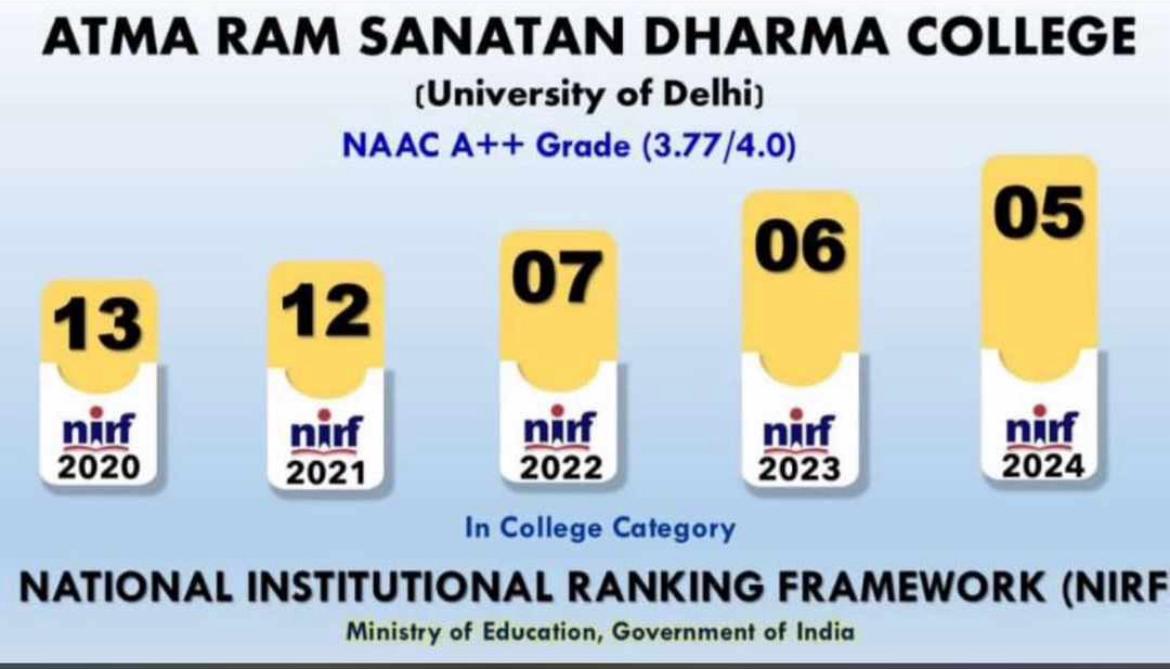
NIRF Rankings, MoE
-
Research and Academic Initiatives
Successful implementation of the research and innovation strategy is evident from the College’s rankings in the NIRF surveys from 2017–22. As per the NIRF Ranking 2022, the College secured 7th rank and recorded the highest Research Publication Score among Delhi University Colleges, demonstrating its commitment to quality research.
-
11 Innovation, 7 Star Innovative and 41 In-House interdisciplinary projects under DBT STAR College Schemes have been completed involving over 400 students, resulting in several publications in Scopus-indexed journals.
-
The College has 17 Research Labs to provide research and internship opportunities. Faculty members published 750 research articles, 256 books/chapters, and several papers in national and international conference proceedings during the last five years.
-
To further orient the faculty and students towards research, the College during the last five years organised 4 week-long FDPs, 2 refreshers, 4 international conferences, 6 national interdisciplinary seminars/conferences and over 600 institutional academic events in both online and offline mode. The conference proceedings have been published in reputed scopus indexed journals/ books.
-
More than 200 faculty members have been involved in several research projects.
-
The College Library has subscribed to the National Library and Information Service Infrastructure for Scholarly Content (NLIST), which provides remote access to e-resources. The College library has also designed and developed a Digital Library and Institutional Repository.
-
Twenty six of our faculty members are guiding 70 research scholars at Post-Doc/ PhD/ MPhil levels and Research Fellows.
-
Our faculty members during the last 5 years have participated in 1131 refresher courses, workshops, orientations, FDPs, and induction programmes.
-
The IQAC initiatives, In-house Interdisciplinary Research and Innovation Projects Scheme, PRABODH, and Central Instrumentation Facility are steps towards establishment of the Research and Development Cell in the College.
-
Under the Vidya Vistar Scheme of the University of Delhi the College has signed MoUs with two colleges in Uttarakhand under the Scheme to promote capacity building and institutional collaboration.
-
The college has signed MoUs with Netaji Subhas University of Technology and Shri Ramswaroop Memorial University, Barabanki, to foster the research environment and provide opportunities for enhancing the technical skills and research temperament.
-
During the pandemic the entire teaching learning process successfully shifted to an online mode as a result of sincere attempts from the IQAC of the College.
-
Placement Activities
The primary objective of the Placement Cell is to provide job and internship opportunities to students. It also organizes workshops and seminars on career related matters. The Cell organizes a Job and Internship Fair annually. Some of our placement partners are GENPACT, KPMG, Wipro, Indigo, BYJU’s, Concentrix, TresVista, E&Y and L&T. The Placement Cell of the College signed up for Coursera for Campus Program which provided free access to around 4000 online courses from leading universities till 30th September, 2020. More than 2800 students registered for this program.
-
Student Enrichment Initiatives
- The College has signed an MoU with National Productivity Council, GoI, to facilitate capacity building and entrepreneurial activities. A 3-months’ course in ‘Internship in Information Technology’ was mutually designed and successfully completed with a batch of 12 students from Delhi NCR.
- The College as a network institute of the Indian Institute of Remote Sensing, Dehradun, a constituent unit of ISRO, GoI, has offered 6 courses on the Basics of Remote Sensing, Geographical Information System and Global Navigation Satellite System.
- The Placement Cell of the College collaborated with Coursera for Campus Program, which provided free access to around 4000 online courses, for which more than 2800 students registered.
- The Skill Development and Entrepreneurship Cell of the College has signed 31 MoUs with various institutions to offer opportunities for skill upgradation through various courses.
- Field visits and academic trips are regularly organized for the students to augment out of classroom learning.
- The College conducted a one-week Export Development Programme and a workshop on “Industrial Motivation Campaign (IMC-Y) for Youth”in collaboration with MSME Development Institute (MSME), GoI.
- The IQAC organized a workshop on “Features of National Career Service” in collaboration with National Institute for Career Services, Ministry of Labour & Employment (GoI).
- In collaboration with NIESBUD, Ministry of Skill Development and Entrepreneurship, GoI, the College organised a 5-day Entrepreneurship Awareness Camp, 1-week FDP on “Entrepreneurship, Motivation and Leadership” and offered short term e-courses.
- The College provides internship opportunities to the students from other colleges and universities in science and library science courses.
- The IQAC organized Counseling sessions in collaboration with Zyego for the mental and psychological well-being of all stakeholders.
- Students were adequately trained in the use of ICT to facilitate online mode of teaching learning through several training sessions and webinars.
-
Teaching-Learning Pedagogy
The faculty of the College believes in using innovative, participative, experiential and interactive pedagogies to enhance the quality of the teaching-learning process through the use of ICT tools and technologies. The College has a fully functional recording studio, easy access to e-resources/journals and a repository of uploaded lectures. The pandemic saw a shift from physical to the virtual mode of teaching-learning, through platforms like G-Suite, MS Teams, LMS Moodle and Zoom. Webinars/workshops were organized on Zoom and Facebook to train the students and staff in this regard.
The IQAC reviews the efficacy of the teaching-learning process through assessment of the lesson plans, Student-Faculty Committees, Mentoring Groups and Feedback Mechanism. The Student-Faculty Committees meet regularly to discuss scholastic and co-scholastic areas. The feedback is duly analyzed and is used in planning and executing the development plans of the institution.
-
Towards Green Campus
The college administration works on the several facets of ‘Green Campus’ including Water Conservation, Tree Plantation, Waste Management and Paperless Work. The College received Green Campus award from the Women’s Agency for Generating Employment in 2017 and the Clean Campus award from the International Association of Educators for World Peace and Confederation of Indian Universities (CIU) in 2017.
In 2020, the college was recognised as the ‘Swachhta Action Plan Institution’ and in 2021, College received recognition for its exemplary performance in Swachhta Action Plan, Green Campus Initiative “One District One Green Champion” by the Mahatma Gandhi National Council of Rural Education, Ministry of Education, GoI.
The College has:
- Strict ‘No Plastic Policy’ with adequate signages displayed.
- Strict ban on burning of dried leaves and waste paper.
- 12 sets of green-blue and 7 sets of green-red-blue garbage bins installed.
- A dedicated Garbage Room.
- Chemical waste from Chemistry and Zoology laboratories is segregated.
- Vast green cover acting as a carbon sink and productive oxygen park.
- Gardens watered using drip/sprinkler irrigation systems.
- First College to implement rainwater harvesting as per Central Ground Water Board guidelines, with a large area reserved for rainwater harvesting units and storage tank.
- A 1260 sq. ft. compost pit functioning as a vermicomposting unit.
- MoUs with agencies like Jaagruti Waste Paper Recycling Services and PomPom Recycling Pvt. Ltd. for degradable and non-degradable waste management.
- A functional Paper Recycling Unit.
- Eco Club sponsored by the Department of Environment, Govt. of NCT Delhi, promoting environmental awareness and tree plantation drives.
- Ground and first floor buildings retrofitted and earthquake-proofed.
- Porta Cabins and third-floor building constructed using sustainable eco-friendly materials like bamboo.
- Green audit conducted for the last three years covering solid waste, energy, water, wastewater, hazardous waste, air quality, and carbon footprint.
- Regular tree census conducted.
- Airy and energy-efficient College buildings and classrooms.
- Reuse of single-sided paper for printing and writing.
- Metal and wooden waste handed over to authorized scrap agents.
- Reuse of glass bottles in laboratories.
- Lab staff and stakeholders trained in e-waste management.
- Accounts Section moving towards paperless operations by issuing digital salary slips, Form 16, and TDS certificates.
- LED lights and solar panels installed for sustainable energy use.
- Installation of a sewage treatment plant in progress.
- Facilities for differently abled persons including ramps, wheelchairs, tactile paths, Divyangjan-friendly washrooms, accessible learning aids, and WCAG-compliant website.
- Restricted automobile entry and pedestrian-friendly pathways.
-
Alumni Engagement
The College has a registered Alumni Association and wishes to involve its alumni in a meaningful manner for the benefit of the students and the institution. It has its own website. The College holds an annual Alumni Meet, Confluentia, that serves as a forum to celebrate alumni achievements, connect and network, and for the alumni to inspire the College body. College also confers distinguished alumni awards.
The Alumni contribute to the corporate life of the institution in the following essential ways:
- Alumni actively participate in talks, events, and workshops, offering hands-on learning experiences, industrial exposure, career advice, and counselling to current students. Rangayan continues its tradition of alumni performances during the annual theatre festival.
- Alumni contribute to scholarships and bursaries to support meritorious students in need. The Alumni Association contributes ₹50,000 annually towards freeships.
- Mr. Uday Turuga donated ₹1,00,000 as an endowment fund in memory of Late Dr. K. C. Trikha (Department of Chemistry) to be awarded to the best B.Sc. (Hons.) Chemistry student.
- Gaurav Mohan Sharma, Director of Alvaro Group, contributed an endowment fund of ₹3,00,000 to support three scholarships of ₹5,000 each for needy and meritorious B.A. (Hons.) Economics students.
- During the pandemic, Mr. Gaurav Mohan Sharma donated four oxygen concentrators—one to the College and three to the University of Delhi.
- The College provided a full fee waiver to 12 students who lost their parents to COVID-19, in collaboration with Gargi and Vidya Prakash Foundation, through the efforts of alumnus Mr. Rajnikant, General Secretary of the Alumni Association.
-
Institutional Social Responsibility and Outreach Activities
The College has a registered Alumni Association and wishes to involve its alumni in a meaningful manner for the benefit of the students and the institution. It has its own website. The College holds an annual Alumni Meet, Confluentia, that serves as a forum to celebrate alumni achievements, connect and network, and for the alumni to inspire the College body. College also confers distinguished alumni awards.
The Alumni contribute to the corporate life of the institution in the following essential ways:
- NSS has adopted Sriram JJ Cluster under the initiative “SEVADEEP” and conducts awareness drives, self-defence programmes, and health check-up camps in collaboration with Connecting Dreams Foundation. Volunteers also interacted with SDMC officials to address water and sanitation issues in the slum.
- Rangayan organized street plays and a Theatre Training Workshop for children from slum communities.
- The Women Development Cell empowers students by creating awareness about socio-political, cultural, and legal issues concerning women through talks, workshops, and symposiums. The Cell conducts its annual 10-day Self-Defence Training Workshop in collaboration with Delhi Police, along with gender sensitization programmes, panel discussions, and interactive sessions with resource persons.
- The Equal Opportunity Cell, in collaboration with Help the Blind Foundation, Hong Kong, provides financial assistance of ₹10,000 each to six visually challenged students.
- The College distributed motorized wheelchairs, scooties, and Apple MacBook Air laptops to differently-abled Delhi University students under its MoU with SDRS.
- Enactus ARSD, through its social entrepreneurship projects, has impacted over 1500 lives and helped create 8 entrepreneurs.
- Pandemic Initiatives:
- Donated groceries, masks, and essentials, and conducted awareness campaigns in adopted villages.
- Crowdfunded to support an ex-student, Chandan Kumar, in continuing his studies.
- Alumnus Mr. Gaurav Mohan Sharma donated four oxygen concentrators for the College and University.
- NSS trained slum children in the use of ICT.
- Full fee waiver provided to 12 students who lost their parents, in collaboration with Gargi and Vidya Prakash Foundation, through the efforts of alumnus Mr. Rajnikant.